
Building AI-Ready Systems with Clean Code, Software Design & Architecture
Build software you can trust — even when AI writes the code.
October 05 - 06, 2026 | Park Plaza Victoria London or Online
October 05 - 06, 2026 | Park Plaza Victoria London or Online
THE BOOTCAMP STARTS IN:
Designed for These Roles
5 Reasons to join
the Bootcamp
Real-World Relevance
Gain a structured understanding of how to use AI effectively in software development

Deep Technical Insight
Learn how to maintain code quality as development speed increases
Hands-On Learning
Develop practical skills through hands-on exercises and real-world scenarios
Proven Technique
Improve your ability to make informed design and architecture decisions
Tool Independence
Strengthen your engineering discipline in AI-driven environments
STAY TUNED!
JOIN OUR NEWSLETTER
5 Things You’ll Finally Feel Confident Doing
- Evaluate and improve AI-generated code
- Apply clean code principles consistently
- Refactor code in a systematic and structured way
- Design systems with maintainability and testability in mind
- Make architectural decisions based on trade-offs and constraints
Differentiation from other IT security workshops
- Software Engineering Practices: Focus on core principles rather than specific tools or frameworks.
- Hands-on Training: Not a framework or AI tools workshop, but a deep, engineering-focused immersion.
- Real-World Systems: Emphasis on improving actual complex systems instead of isolated demo examples.
- AI-Assisted Workflow: AI is integrated to support quality, not to replace critical engineering judgment.
- Engineering Judgment: Developing decision-making skills instead of following predefined recipes.
- Design & Quality: Strong focus on code quality, maintainability, and sustainable system design.
- Refactoring-First Approach: Architecture that evolves through continuous improvement rather than rigid upfront design.
- Realistic Scenarios: Practical exercises based on the messy realities of production environments.
- Trade-off Awareness: Explicit consideration of real-world constraints and the evolution of systems over time.
Bootcamp Day 1
Day 1 focuses on the foundations of high-quality software development and their role in AI-augmented engineering. Well-structured, readable, and maintainable code has always been essential—but becomes critical as AI accelerates how code is produced.
AI is a powerful assistant—but should you trust it with your code? As more code is generated faster, the risk is not less work, but more complexity. Poor code slows development—and with AI, it scales faster than ever. Without strong engineering discipline, teams quickly lose control over code quality, maintainability, and system behavior.
The key challenge is not adopting AI—it is using it in a way that produces reliable, understandable, and maintainable results in real-world systems.
Participants will work through practical coding challenges, compare human and AI-generated solutions, and systematically improve code through hands-on refactoring. The goal is to build a disciplined approach that allows teams to leverage AI effectively—without creating hidden technical debt or long-term instability.
Key topics:
- AI-assisted coding: strengths and effective application in development workflows
- AI is a powerful assistant—but should you trust it with your code?
- Using AI successfully: what must be in place to ensure quality and control
- Comparing human vs. AI-generated solutions in practical scenarios
- Improving and hardening AI-generated code for production readiness
- Poor code slows development—how AI amplifies this effect
- Hands-on refactoring: step-by-step code improvement techniques
- Clean Code principles and expressive programming
- Designing for testability and maintainability
- Sustainable coding practices in team environments
- Peer review and collaborative learning
Bootcamp Day 2
Day 2 shifts the focus from code-level quality to system design and architecture—and their role in keeping systems stable and evolvable as complexity increases. Clean architecture, clear system boundaries, and deliberate design decisions are not optional—they are required to keep systems under control when new capabilities like AI are introduced.
Good software isn’t theoretical—it evolves under real-world constraints. As systems grow and AI-driven capabilities are added, weak architectures quickly become bottlenecks. Without clear structure, systems become harder to change, risk increases, and teams lose the ability to evolve their software safely.
The key challenge is not designing perfect systems upfront, but continuously improving structure and making sound architectural decisions under pressure.
Participants will work through real-world scenarios, improving systems step by step and learning how to make decisions that hold over time. The focus is on understanding design forces, managing trade-offs, and applying patterns only where they create real value.
You’ll leave with practical skills that directly impact your daily work—and the ability to take responsibility for systems that must remain stable, flexible, and maintainable in an AI-driven environment.
Key topics:
- Evolutionary architecture vs. Big Design Up Front
- Transforming legacy systems through incremental improvement
- Applying SOLID principles in real-world scenarios
- Managing architectural trade-offs under real constraints
- Understanding design patterns in context
- Design patterns should emerge naturally—not be forced
- Identifying design forces before selecting patterns
- Applying patterns pragmatically to real problems
- Avoiding over-engineering and unnecessary complexity
- Hands-on architectural decision-making exercises
Requirements
-
-
- Laptop with a configured development environment (e.g., IntelliJ IDEA, VS Code)
- Access to AI-assisted coding tools (e.g., GitHub Copilot or similar)
- Local development setup with build tools (e.g., Maven, Gradle)
- Willingness to actively participate in hands-on coding exercises
-
Trainer

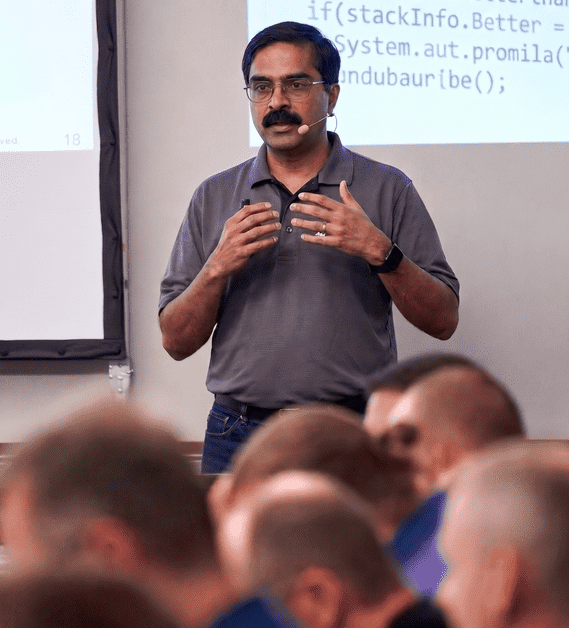
Dr. Venkat Subramaniam
Dr. Venkat Subramaniam is an award-winning author, founder of Agile Developer, Inc., and an instructional professor at the University of Houston. He has trained and mentored thousands of software developers in the US, Canada, Europe, and Asia, and is a regularly-invited speaker at several international conferences. Venkat helps his clients effectively apply and succeed with sustainable agile practices on their software projects. Venkat is a (co)author of multiple technical books, including the 2007 Jolt Productivity award winning book Practices of an Agile Developer.
Secure Your Spot
* incl. 10% group discount when buying 3 or more tickets, plus VAT
